Einar Harnes
The SonEinar Harnes is an Oslo lawyer whose work for society’s most marginal clients gives his firm a public identity as a defender of the desperate, while a hidden, reliably paying client keeps the practice in business. His role in pressing Sonny Lofthus to confess connects the legal system’s shabby margins to the corrupt network around Arild Franck and Hugo Nestor: Harnes is not merely a failing advocate but a participant in the machinery built to frame Sonny.
Identity and Practice
Harnes has little interest in saving the world; he wants to improve only the small part of it that is his. He studies just enough law to pass his examinations, then works for a firm at the bottom of Oslo’s legal system long enough to obtain his licence. He subsequently starts Harnes & Fallbakken with Erik Fallbakken, an ageing, borderline alcoholic lawyer. They accept hopeless cases and lose them, acquiring a reputation as representatives of society’s lowest-status clients in the process.
The firm’s poor organization and precarious clientele make it an unlikely source of security. Its invoices are paid, if at all, when clients receive benefits; the filing system is described as chaotic, and the secretary is often on sick leave. Harnes’s ordinary business is less about delivering justice than threatening lawsuits on behalf of people who pay him to threaten others. He employs ineffective staff at minimum wage and promises prospective clients that they will win. Against this background of unreliable fees and implausible promises, one undisclosed client stands out: that client pays promptly, usually in cash, and rarely asks for an invoice. Harnes’s ability to take on expensive work depends on this concealed source of income.
Connection to the Criminal Network
Harnes’s relationship with Arild Franck is visible in the unusual arrangements surrounding his visits to Staten Maximum Security Prison. Franck generally lets him enter through the staff changing rooms’ back door, avoiding a formal sign-in and the speculation that might follow from a lawyer with Harnes’s reputation visiting so often. When Sonny is held in solitary confinement, Franck arranges for an interview about a new criminal case to take place inside the prison rather than at Police Headquarters. Harnes is present there as Sonny’s lawyer, but the secrecy and setting place his legal work within Franck’s sphere of influence.
The commercial relationship becomes more explicit when Harnes meets Franck at Staten. Harnes jokes that seeing Franck’s Porsche Cayenne made him raise his fees, describing the extra charge as antisocial work. He also refers to Nestor in connection with the payment. The exchange makes clear that Harnes’s services are being purchased by people in the criminal network, not simply by a client seeking ordinary legal representation. His professional identity as a defender of the poor thus coexists with paid work for those who exploit the institutions in which poor and vulnerable people become trapped.
Pressuring Sonny to Confess
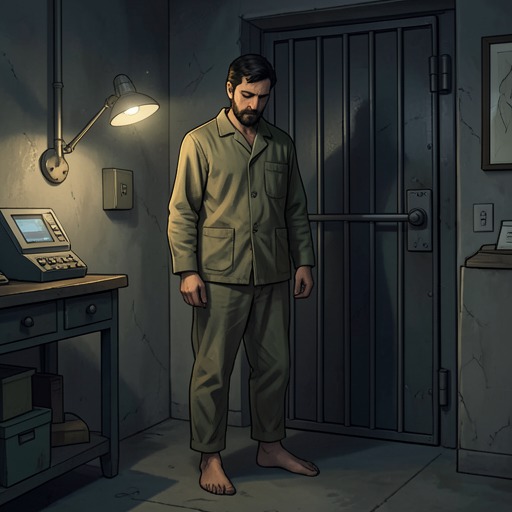
Harnes approaches Sonny six days after the notorious interview, while Sonny is enduring withdrawal in prison. Reports reaching Harnes say Sonny has refused offers of speed and cannabis and has spent long hours exercising, even as he struggles. Harnes understands that Sonny’s ability to persist is unusual, but his concern is not framed as care for his client. His paymaster wants results, and Harnes is there to obtain Sonny’s signature on a confession.
He argues that DNA evidence will secure Sonny’s conviction whether or not he confesses, presenting a guilty verdict as inevitable and the confession as a way to avoid prolonging the ordeal. When Sonny does not respond, Harnes offers to have a bag of Superboy brought to him within an hour, making access to drugs part of the pressure. He taps the three pages on his briefcase and says that all he needs is Sonny’s signature. The appeal to evidence, the promise of drugs, and the paperwork work together: what is staged as legal counsel is also an attempt to secure a version of events useful to the people paying him.
Harnes’s pressure reflects the wider fabrication of Sonny’s apparent guilt. The evidence against Sonny is made to look conclusive, while details that might unsettle the case are ignored or managed. In the earlier investigation of Kjersti Morsand’s murder, her friend reported that her husband, Yngve, had accused her of an affair and threatened to kill her; Kjersti was afraid, and was considering leaving him. The account identifies a conventional motive for Yngve, while also raising unanswered questions about the boy’s motive and the missing sleeping tablets. Such gaps matter because the case is not simply a contest between evidence and confession: the people shaping the investigation can decide which clues receive attention and which narrative becomes official.
The Network Behind the Case
The larger scheme depends on cooperation across institutions. Nestor arranged for Yngve Morsand to kill his wife himself, while paying to have someone else take the blame. The agreed price was three million kroner. Franck helped organize the arrangement, including Sonny’s day release and whereabouts, and a corrupt, well-paid prison officer was sent with him. Harnes’s demand for a signed confession belongs to this effort to make Sonny the fall guy for a murder committed by another person.
The book’s account of the criminal organization also complicates the idea that corruption has a single source or a lone police mole. Simon recalls old rumors that a mole in the police force passed information to the person running much of Oslo’s drug and sex-trafficking trade, a figure known as the Twin. Later, Ab Lofthus’s diary reveals the more surprising structure: there were two corrupt officers, whose partnership meant that one could provide an alibi when the other was active. They had turned a blind eye to drug dealing, human trafficking, and murder, and communicated with the Twin through separate Hotmail accounts on stolen computers, leaving envelopes at agreed drop points. This evidence places Harnes’s paid legal work within a wider system where criminal influence travels through prison access, police information, and financial arrangements rather than relying on one corrupt official.
Narrative Role and Significance
Harnes is a consequential supporting figure because his ordinary legal tools—access to a client, arguments about evidence, and documents awaiting a signature—are put to work for a criminal purpose. His firm’s reputation as a champion of people at society’s margins makes the contrast especially sharp: the lawyer who claims to serve the powerless helps advance a case designed to sacrifice one of them. His work shows how a confession can be manufactured through pressure even when it appears to confirm an existing evidentiary case.
His characterization also helps connect the novel’s procedural mysteries to its institutional critique. The investigation repeatedly turns on how evidence is assembled and interpreted: an investigator advances a robbery theory before the facts have been established; Simon explains how cleaned blood and a rug can reveal the killer’s movements; and a shell casing links the killing of Agnete Iversen to the same ammunition used in another murder. Against this chain of observations and deductions, Harnes represents the deliberate distortion of a case narrative. His efforts to obtain Sonny’s signature are not a resolution of uncertainty but an attempt to bury it under a confession that serves the people who arranged the crime.